


Time and again, headlines such as “Fathers earn, mothers manage” or “Care work: Who pays for the invaluable work?” make the rounds. They usually refer to domestic and family work – from cooking and cleaning to childcare. Especially around the women’s strike, the issue and possible political responses receive heightened media attention. One recurring proposal is to have the state pay for unpaid care work in order to make its importance more visible. Below, we address six key questions on this topic that repeatedly arise in the debate.
1. Everyone talks about care work – but what actually counts as care work?
There are different definitions and interpretations of the term. According to the Swiss Federal Statistical Office (FSO), “unpaid work” includes domestic tasks (such as cooking, cleaning, laundry, and administrative duties), care work (for children and adults in need of care), and volunteer work (including unpaid and voluntary activities as well as assistance provided to relatives and neighbors). In Switzerland, the extent of these activities has been measured through population surveys since 1997. According to the FSO, people in Switzerland spend an average of 28.7 hours per week on unpaid work.
That covers the statistics. However, the activities listed raise an important question: is the term “work” always being used here in the same way as in everyday language? Probably not. After all, tending the garden, playing with one’s children, spending an afternoon baking Christmas cookies, or coaching a junior team at a soccer club would hardly be considered “work” in a strict sense. The FSO category of “unpaid work” is therefore difficult to distinguish from leisure activities, which means the figures should be interpreted with caution (see also info box).
2. How is unpaid work distributed between men and women?
In 2024, men accounted for around 40 percent of unpaid work, while women accounted for roughly 60 percent. In the late 1990s, men’s share was still about one third and women’s about two thirds. This points to a gradual convergence between the genders. A similar trend can be observed in paid employment, albeit with reversed gender shares. While women accounted for around 32 percent of total paid working hours in the late 1990s, their share today is approximately 40 percent.
3. Should private domestic and family work be compensated with tax revenue?
No, because this would create more problems than it solves. In addition to the difficulty of clearly defining the activities, the amount of work would also need to be monitored – and how this could be done is entirely unclear. Would we be required to keep work logs, and would authorities check how much time we actually spend cooking or cleaning? Even with a massive monitoring system, this would be barely feasible – and even on a smaller scale, it would constitute a significant intrusion into ones privacy.
On the other hand, if measurement and monitoring of the performed work are abandoned, one would essentially end up with some form of universal basic income. After all, practically everyone performs some amount of unpaid work and could thus claim compensation from the state.
And this already leads to the next point.
4. Would full compensation for unpaid work be financially feasible on a broad scale?
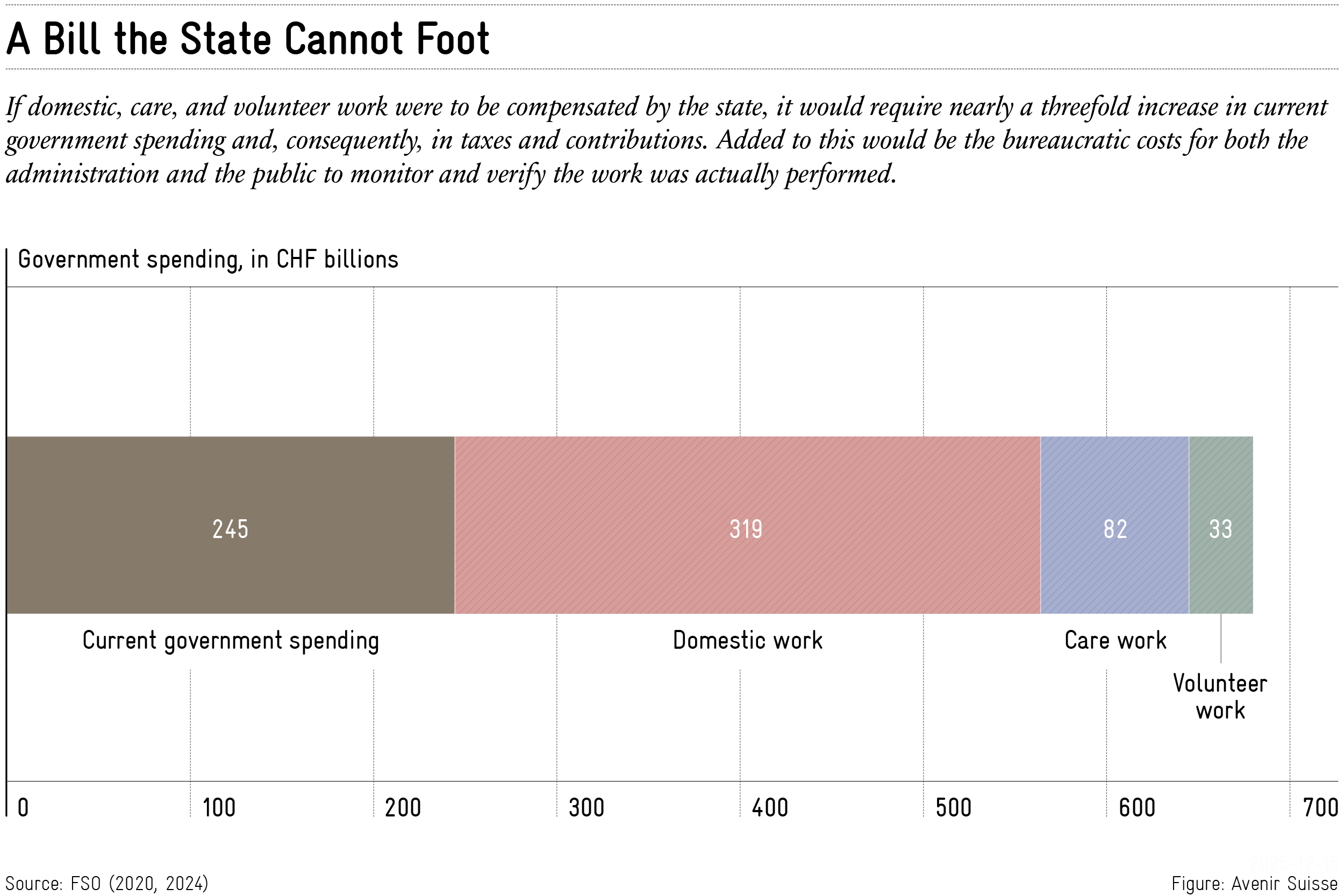
A rough calculation shows that state payment for unpaid work would not be financially feasible. The estimated CHF 434 billion required to compensate the roughly 10 billion hours of domestic, care, and volunteer work performed annually in Switzerland amounts to about half of the country’s gross domestic product (GDP) – that is half of the entire market-based value creation in Switzerland. If these activities were publicly funded, it would almost triple government spending, necessitating additional taxes. However, if wages were taxed three times as much while domestic work at home suddenly became state-compensated, many people might withdraw from the labor market. This, in turn, would require an even higher tax and contribution burden on those still working – a vicious cycle would ensue.
5. Would public funding of unpaid work be an effective tool for poverty reduction?
No, because everyone would receive payment for cooking and cleaning, regardless of their financial situation. This is neither effective nor efficient. The state should provide support where people are unable to manage on their own. Therefore, the question should be less about “which activities do we want to promote?” and more about “which households need support?” Needs-based benefits, such as individual health insurance subsidies, social assistance, or supplementary benefits, target these households more precisely, are more financially feasible, and are thus more effective and efficient than general payment for various activities.
6. Would public funding of unpaid work promote gender equality?
Public funding of unpaid work is unlikely to promote gender equality. On the contrary, it could even reinforce traditional roles, as the implicit message might be interpreted as: “We’ll pay you, so you can stay at home.” This could further entrench conventional gender expectations.
From a gender equality perspective, the key point remains: women and men should be able to make their decisions as independently, well-informed, and free from state interference as possible. Achieving this requires two things:
- (Financial) education: Today, both genders generally have access to good education and career opportunities, allowing contributions to domestic and paid work to be negotiated on a more equal footing. This is the path toward greater equality, as it cannot be imposed from above but must be practiced in everyday life. Financial education is also important, for example, understanding the impact of career breaks or part-time work on retirement pensions.
- Neutral framework conditions: To enable people to shape their lives independently, state policies need to be designed as neutral as possible. The government should not steer decisions in a particular direction – such as favoring a specific family model. Today, for example, the tax system makes domestic work particularly attractive for secondary earners compared with paid employment. Eliminating such distortions is an important step toward greater gender equality.
In short: Domestic, care, and volunteer work are indispensable for the functioning of any society. However, measures such as public funding of unpaid work are neither practical nor financially feasible, and they are certainly not realistic. Instead, we should focus on effective and affordable instruments that target areas where support is truly needed and create framework conditions that allow all individuals to shape their lives as independently as possible.
Info Box: How is data on unpaid work collected in Switzerland – and how reliable is it?
The data come from the “Unpaid Work” module of the Swiss Labor Force Survey (SLFS).
However, comparability over time is limited. Since 1997, the module has been revised multiple times. in 2021, the survey also shifted from a purely telephone-based to a mixed-mode approach, and the questionnaire was adjusted. These changes created a break in the series, which is clearly reflected in the results: between 2020 and 2024, the reported hours of unpaid work per person increased by 19%. Certain activities saw particularly notable increases: dishwashing (+56%), shopping (+53%), laundry (+64%), and adult care and supervision (+118%).
Such abrupt jumps within just a few years seem implausible, especially in areas where modern household appliances would be expected to save time. The figures therefore provide valuable insights but should be interpreted with caution.


