Switzerland has few natural resources — its real strength lies in its “gray cells”: a well‑educated population and an attractive research environment. The federal government now plans to trim its funding for this key asset. Under the so‑called “Entlastungspaket 2027” (EP27), not only universities but also Switzerland’s national research agencies would receive temporarily reduced funding.
The plan aligns with recommendations from an expert group: subsidies to the Swiss National Science Foundation (SNSF) are to be CHF 131 million lower in 2027 than originally planned; contributions to Innosuisse would be cut by CHF 32 million.
In the winter session, the Council of States is set to debate the EP27 — even though a relevant parliamentary committee has already rejected these proposed cuts. Members of the education and research community have issued strong warnings about the potential negative effects on Switzerland’s economy and its status as an innovation hub.
Is the government straying off course, as its critics argue? Could the EP27 imperil the country’s research capacity and innovative edge? This article takes the opposite view and sets out five reasons why, in the current context, the planned cuts make sense.
1. The cuts come after years of strong growth
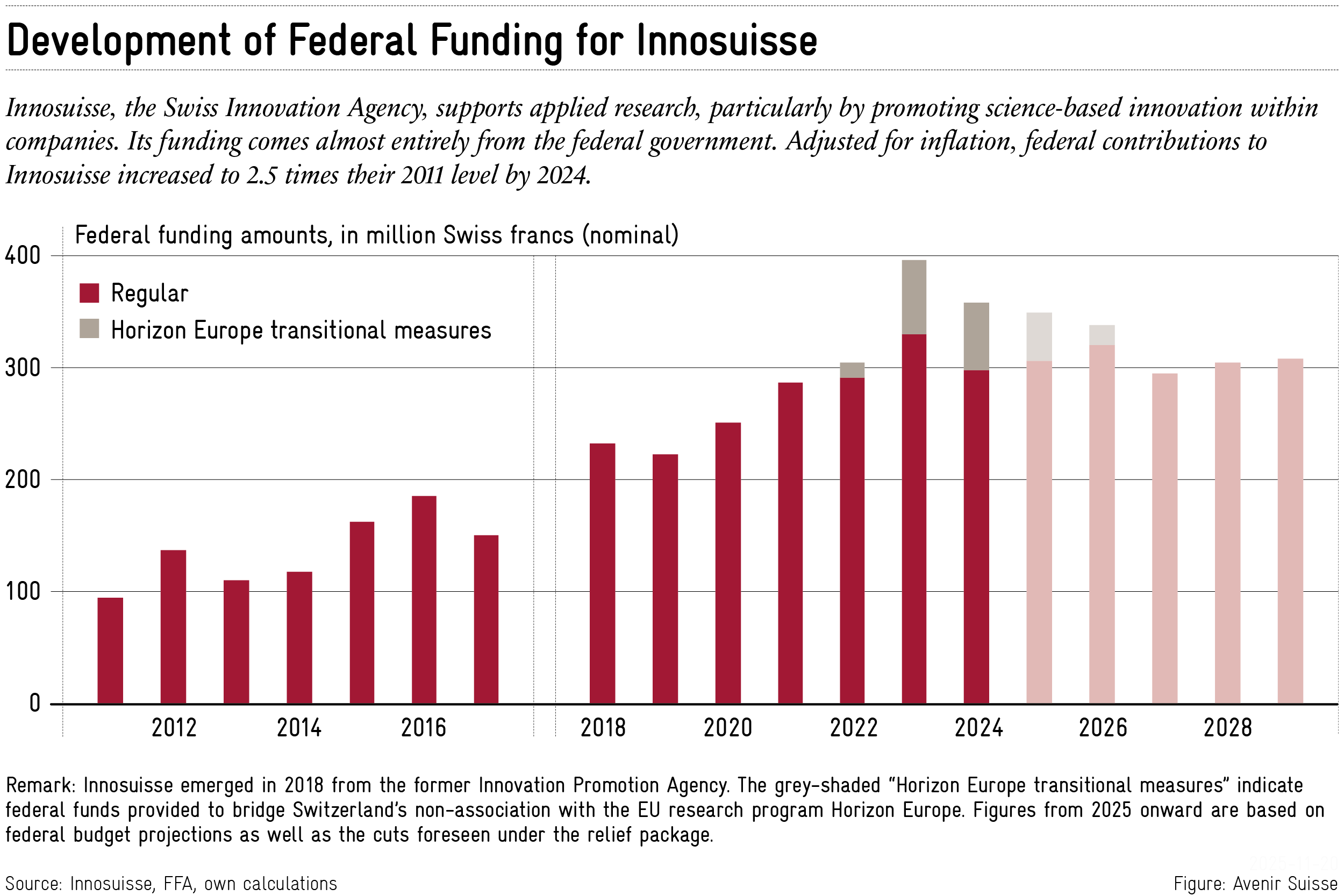
The SNSF’s and Innosuisse’s budgets have risen sharply over the past years. In 2024 the federal government allocated just over CHF 1.32 billion to the SNSF — an inflation‑adjusted near‑tripling since the introduction of the debt brake in 2003. In the same year, Innosuisse received roughly CHF 357 million from the federal budget. Adjusted for inflation, that is 3.5 times what its predecessor organization (KTI) received in 2011 — when the government expanded its remit.
Contributions to the two research funding agencies have increased sharply compared with other areas of federal spending. Since 2011, federal contributions for the SNSF has increased by an inflation-ajusted-average of 2.7% per year ; t hose for Innosuisse (and previously the CTI) by as much as 10.2% per year. This means their growth has clearly outpaced that ofthe overall federal budget (around 1.7% per year), and economic growth over the same period was also significantly lower (around 1.8% per year).
2. The pause in spending growth is temporary
The EP27 represents a one‑time “reset” of spending levels. In effect, SNSF funding would revert to its 2020 level, and Innosuisse funding to that of 2022.
This may offer a useful moment for both agencies to re‑evaluate their priorities and strategies. Moreover, according to the federal financial plan, funding is slated to rise again after 2027 — at projected rates of about 2.8 % per year for SNF and 2.2 % for Innosuisse.
Figure 1

Figure 2
3. Switzerland already spends generously on public research by international standards
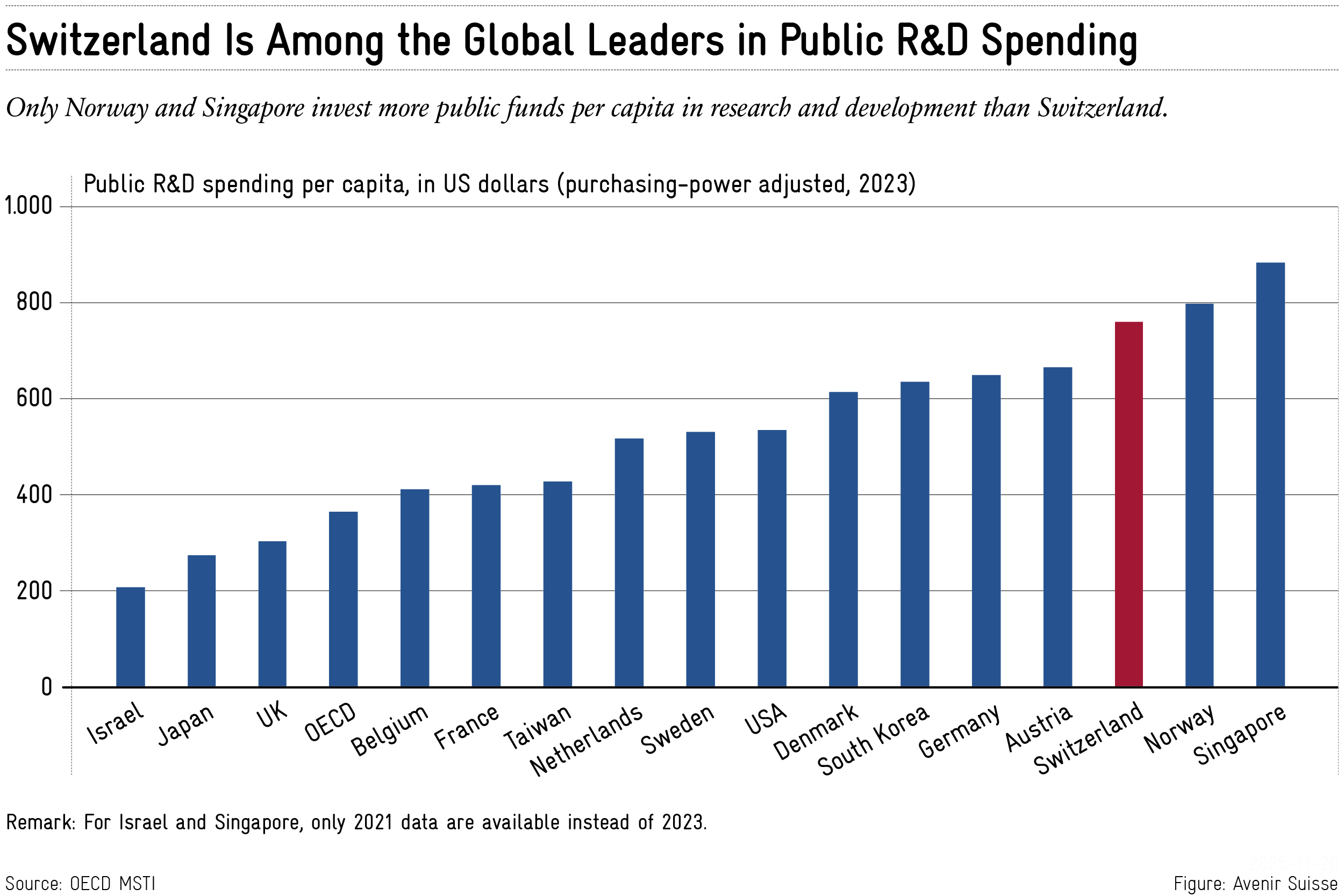
Even before these adjustments, Switzerland’s public support for research and development is high: only a few countries worldwide — such as Singapore or Norway — exceed Switzerland’s per‑capita public R&D expenditure.
Indeed, since 2012 Switzerland has consistently ranked among the top three globally in public R&D spending per capita. The proposed reductions amount to less than 2.5 % of total state R&D spending — a modest cut in the broader context.
4. The private sector shoulders the bulk of research investment
In 2023, total spending on research and development in Switzerland reached CHF 25.9 billion. Roughly 70 % of that came from the private sector — a share that has remained stable as absolute investments grew.
The planned federal reductions therefore correspond to only about 0.6 % of total domestic R&D expenditure. This suggests that critics who warn of a collapse in innovation may be overlooking a key part of the puzzle.
Figure 3
5. Switzerland will remain strong in basic research
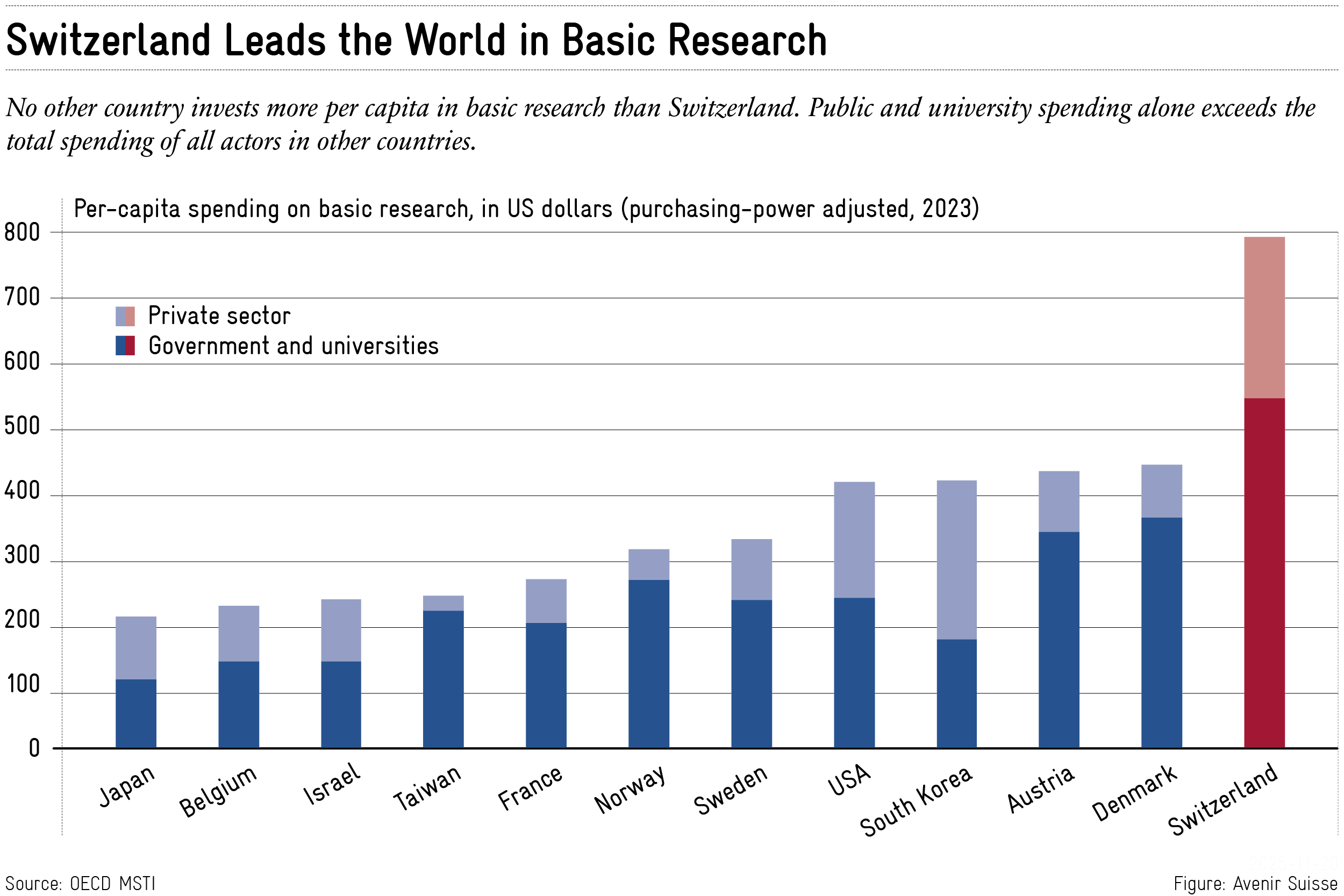
By longstanding tradition, the state plays a central role in fundamental research — the kind of work that builds knowledge, technology, and human capital, and underpins both startup formation and long-term innovation. Among OECD countries, no other nation invests more heavily in basic research per capita than Switzerland.
The brief funding pause under EP27 will not undermine Switzerland’s leading position. Long-term financing remains secured: from 2028 onwards, federal contributions are projected to grow again by about 3 % per year.
Public research funding is not Switzerland’s only advantage. The article concludes that what truly matters for maintaining a vibrant innovation ecosystem is smart allocation of funds, fiscal stability, and a favorable environment for private-sector commitment. In that light, the EP27 — far from threatening the research landscape — is a prudent step toward sustainable public finances while preserving Switzerland’s long-term competitive edge.
Figure 4
Public Research Spending Is Not Switzerland’s Only Competitive Advantage
Despite the controversy surrounding EP27, the five points outlined above make one thing clear: the Federal Council’s proposals do not call into question either the attractiveness of Switzerland as a research hub or the country’s innovative strength. The fundamental orientation of Swiss research and innovation policy remains unchanged. Public funds will continue to flow primarily into education, basic research, and the transfer of knowledge and technology.
At the same time, the foundations of Switzerland’s research landscape must be secured sustainably. On the one hand, the new geopolitical environment requires an adjustment of priorities — security considerations are once again gaining importance. On the other hand, public funds for research must ultimately be earned. Without the relief package, Switzerland would need to rely on higher taxes or additional debt. That, in turn, would burden companies and entrepreneurial individuals — those who generate the very resources that finance this country’s forward-looking research.
The conclusion is straightforward: sound public finances and the right spending priorities are, over the long run, essential to safeguarding research and innovation in Switzerland.