The path to citizenship varies widely across countries. Traditional immigration nations such as the United States, Canada, and Australia grant citizenship to anyone born on their soil – a principle known as jus soli. Switzerland, like many other countries, follows a different logic: citizenship is primarily based on descent (jus sanguinis), meaning that Swiss nationality is inherited from Swiss parents.
Alongside citizenship by birth or adoption, another route has grown in importance: naturalization. Here is an overview of the key questions and answers.
1. How does one become Swiss?
“Ordinary” naturalization is open to foreign nationals who have lived in Switzerland for at least 10 years. Applicants must also meet integration requirements, including strong language skills and financial self-sufficiency without reliance on social assistance. A faster, “facilitated” process is available to people married to a Swiss citizen or to those whose families have lived in Switzerland for three generations.
The exact criteria, however, vary widely across cantons and municipalities. Additional integration requirements and minimum residency periods at the local level differ, as do costs. In the canton of Appenzell Innerrhoden, the process costs about CHF 1,100; in Solothurn, fees can climb to as much as CHF 5,600, depending on the municipality. In principle, fees are meant to cover only administrative costs.
2. How common is naturalization?
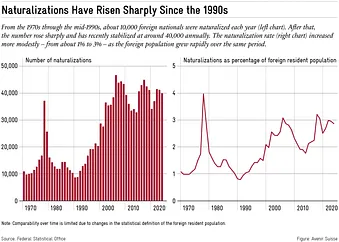
Only a small share of eligible residents actually apply for citizenship. Still, the number of naturalizations has risen sharply over the past decades. Since the turn of the millennium, about 962,400 people have acquired Swiss citizenship – an average of 38,500 per year, several times higher than in the 20th century.
Because the foreign population has grown at the same time, the naturalization rate has increased less dramatically. Today, about 2 to 3% of foreign residents are naturalized each year. Slightly more than one-third of those naturalized were born in Switzerland, and about one in five cases occurs through the facilitated procedure.
3. Who becomes Swiss?
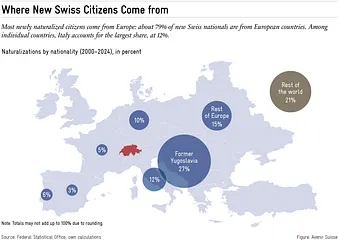
Naturalization patterns often reflect earlier waves of immigration. Since 2000, about 79% of those naturalized have come from Europe, with 29% originating from neighboring countries. The composition of origin groups has shifted significantly over time. In the early 2000s, people from the former Yugoslavia accounted for as much as 40% of new citizens; today, that share has fallen to around 13%.
Interest in naturalization also varies by origin. Since 2000, the average naturalization rate has been about 1.5% for citizens of EU countries, 3.2% for other Europeans, and 3.8% for people from outside Europe. In recent years, however, these differences have narrowed. In 2023, the rates were 1.7% for EU nationals, 2.2% for other Europeans, and 2.1% for non-Europeans – a convergence that may reflect a revised citizenship law introduced in 2018.
But how many immigrants ultimately become citizens? Among those who immigrated in 1998 and still live in Switzerland, about half had obtained Swiss citizenship two decades later.
4. Are there regional differences?
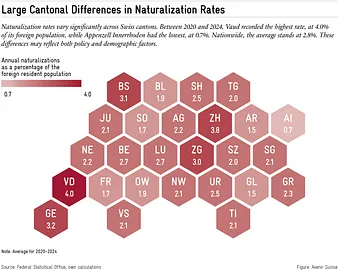
Naturalization rates vary significantly across cantons. In the canton of Vaud, about 4% of foreign residents were naturalized annually over the past five years, compared to just 0.7% in Appenzell Innerrhoden. Such differences do not necessarily reflect stricter or more lenient policies. Demographic factors – including age structure and country of origin – can also play a role.
5. What are the effects of naturalization?
Rising naturalization rates reflect broader political efforts to promote integration. Empirical studies suggest that citizenship can have positive long-term effects on social, economic, and political integration (see Hainmüller et al. 2015, 2017 and 2019).
As more immigrants become citizens, the statistical boundary between “foreign nationals” and “Swiss” is increasingly blurred. Many people with a migration background now hold Swiss passports. Today, roughly one million naturalized citizens live in Switzerland (see also our article on foreign residents in Switzerland). Without naturalization, the number of Swiss citizens would have declined since the early 1990s, and the share of foreign residents would stand at about 39% instead of the current 27%.
6. How does Switzerland compare internationally?
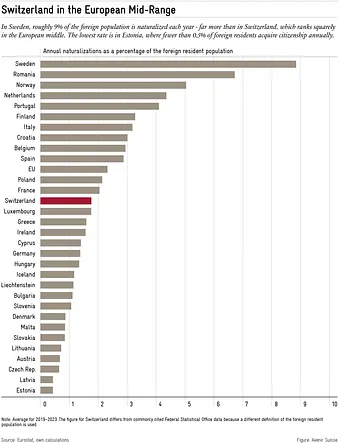
By European standards, Switzerland sits in the middle range when it comes to naturalization rates. While it grants a relatively large number of citizenships, it also has an unusually high share of foreign residents.
7. What political reforms are under discussion?
A popular initiative currently before Parliament – “For a Modern Citizenship Law” – calls for uniform national rules for naturalization. It proposes granting a right to citizenship after five years of residence, instead of ten.
Applicants would need to have no serious criminal convictions, pose no threat to Switzerland’s internal or external security, and demonstrate basic knowledge of a national language. Other current integration criteria – such as financial independence or participation in social life – would be eliminated, along with cantonal and municipal residency requirements.
A separate set of negotiations between Switzerland and the European Union is unlikely to affect naturalization directly. Any impact would likely be indirect, for example through increased immigration if more stable residency rights encourage people to remain in Switzerland long-term. A permanent residence permit after five years would not, however, entitle someone to Swiss citizenship. A settlement permit would still be required (see also our article Many Paths Lead to Switzerland).
Background: The 2018 Citizenship Reform
On Jan. 1, 2018, a fully revised citizenship law came into force. The reform aimed to simplify Switzerland’s multi-level naturalization system and harmonize requirements across federal, cantonal and municipal levels.
At the same time, the government reaffirmed a core principle: citizenship should mark the final step of successful integration – and therefore come with high standards..
The reform both relaxed and tightened certain rules. Applicants for ordinary naturalization must now hold a permanent residence permit (Permit C). At the same time, the required length of residence was reduced from 12 to 10 years at the federal level. Cantons may still impose additional residency requirements, but these are limited to two to five years.
Integration criteria were also clarified. Federal law now explicitly requires applicants to demonstrate oral and written proficiency in a national language, respect for public order and security, and participation in economic life or education.
Another change concerns facilitated naturalization: since 2018, third-generation immigrants can apply under simplified conditions.
Migration Insights
Migration is shaping Switzerland—politically, economically, and socially. Hardly any other topic is debated as intensely and emotionally. With its blog series on migration, Avenir Suisse sheds light on the many facets of immigration to Switzerland. We provide data and facts to foster a better understanding of Switzerland as a country of immigration.