






The federal government introduced the Electronic Patient Dossier (EPD) to accelerate the digital transformation of Switzerland’s health care system. Medical information was meant to become easily accessible, while reducing duplicate work and information loss. Yet since its launch in 2021, the system has failed to gain traction and has proven impractical for everyday clinical use. The federal government alone has spent CHF 80 million on the project. Now, the government is making another attempt: the Electronic Patient Dossier is to become the Electronic Health Dossier (EHD). For policymakers, it has become the next flagship project.
Standards, Not State Systems
Instead of launching another large-scale government project with an Electronic Health Dossier, the federal government should focus on establishing the rules for secure and seamless data exchange.
Essential: digitize Switzerland's healthcare system
Why does this matter?
What are the facts?
48%
48% of physicians exchange patient medical information electronically with other health care providers. This places Switzerland — together with Germany — at the bottom of a comparison group of OECD countries.
Patient dossier without demand
Only 1.4% of the population has opened an Electronic Patient Dossier (EPD). Of these, fewer than 30% have granted access to a healthcare professional.
Falling behind digitally
Switzerland ranks among the world’s leading countries in health care innovation. However, when it comes to digitalization, it ranks only 19th out of 32 countries, according to the American Foundation for Research on Equal Opportunity.
The US and Denmark as pioneers
The United States and Denmark are among the leaders. The lesson from both countries is: interoperability and standards first, then digital applications. The US, with its competitive market structure, relies on a private ecosystem of applications.
Standards and interfaces
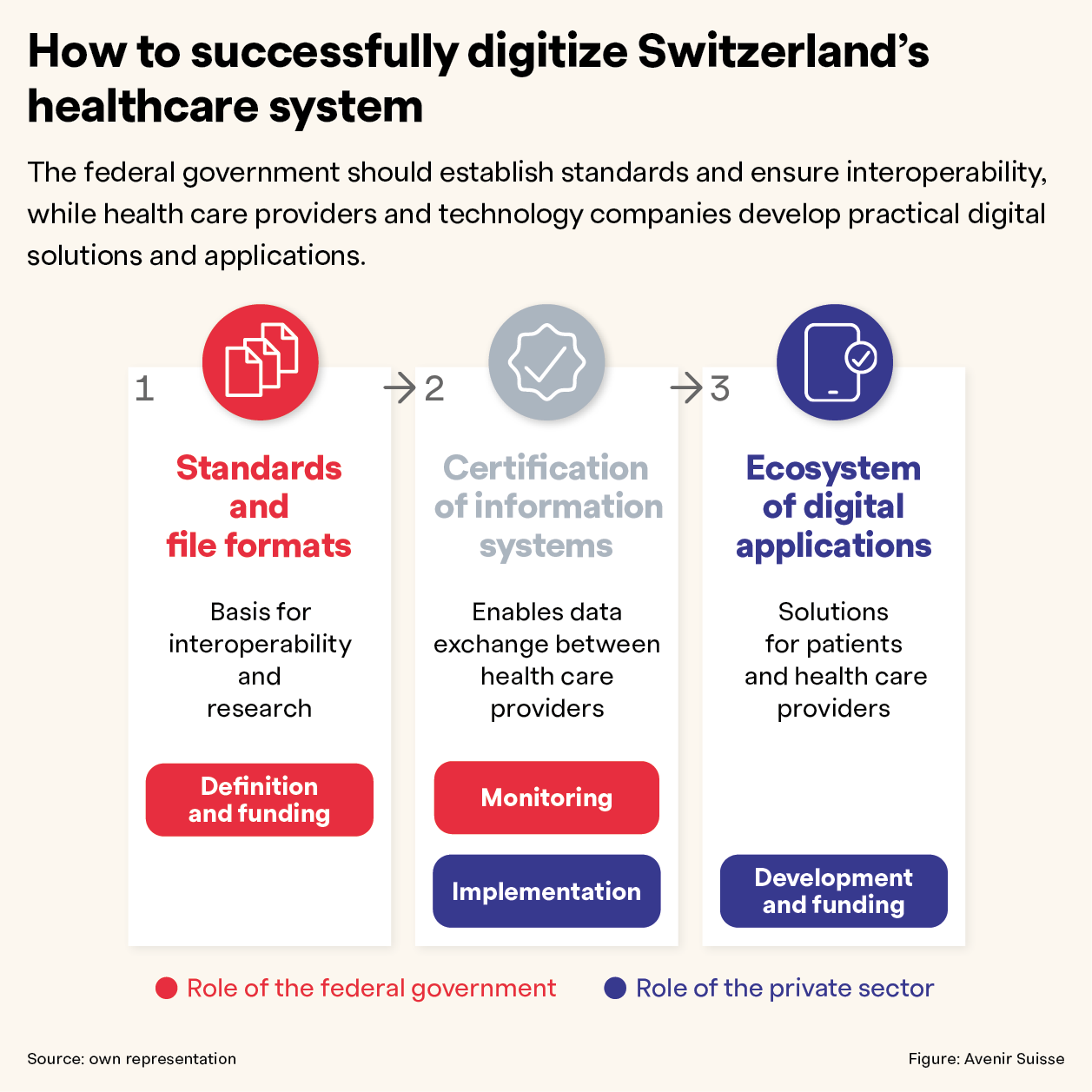
The greatest obstacle to digitalizing health care is not the absence of a government health record, but the inability of existing information systems to communicate with one another. This is also the main reason why Switzerland lags behind internationally.
Image

What are the implications?
Government has an important role to play in the digital transformation of health care — but not by operating a government-run Electronic Health Dossier. Instead, the federal government should focus on what only it can do: establish binding standards and interfaces for data exchange and ensure compliance with them. Health data should remain decentralized, stored by hospitals and physicians’ practices. Once this foundation is in place, digital applications can emerge through decentralized innovation and competition —where they create real value for patients and health care providers, whether in medication management, the secure exchange of treatment data, or the development of new therapies.
Questions or suggestions?
Image

Your contact:
Christoph Eisenring