


The facts speak for themselves: over 20 billion francs in service surpluses in favor of the U.S., around half a million jobs created, and the highest average wage among all foreign employers. Switzerland has a lot to offer the U.S. economy. Yet Trump now wants to impose the highest punitive tariffs on imports from our country.
The case shows that in global trade policy, facts matter less and less. Instead, strategic calculations prevail — with unclear rules and shifting motives. In the current case, causes such as the high goods trade deficit or drug prices are being cited. Whatever the official justification, one thing is clear: Swiss industry is coming under pressure—and with it, the entire business location.
Uncertainty is the new normal
The U.S. is Switzerland’s most important export market at the country level. New trade barriers threaten not only existing supply chains but also investment relationships that have developed over decades. While many Swiss products are highly specialized and difficult to replace, this offers only limited protection against political arbitrariness, which creates ongoing uncertainty.
Beyond the potential punitive tariff, it’s especially the planning uncertainty that burdens the economy: companies lose the ability to plan investments long-term, organize supply chains reliably, or make location decisions with confidence. This strategic uncertainty is just as serious for an export-oriented economy like Switzerland as high tariffs.
Swiss Agricultural Protectionism
This is precisely why it’s crucial for Switzerland to remain credible in economic policy. Those who demand fair trade conditions in Washington should not ignore their own barriers. These exist primarily in the agricultural sector: with an average agricultural tariff of 24.8%, Switzerland is among the most restrictive markets in the world. The tariffs are three times higher than in the EU and six times higher than in the U.S.
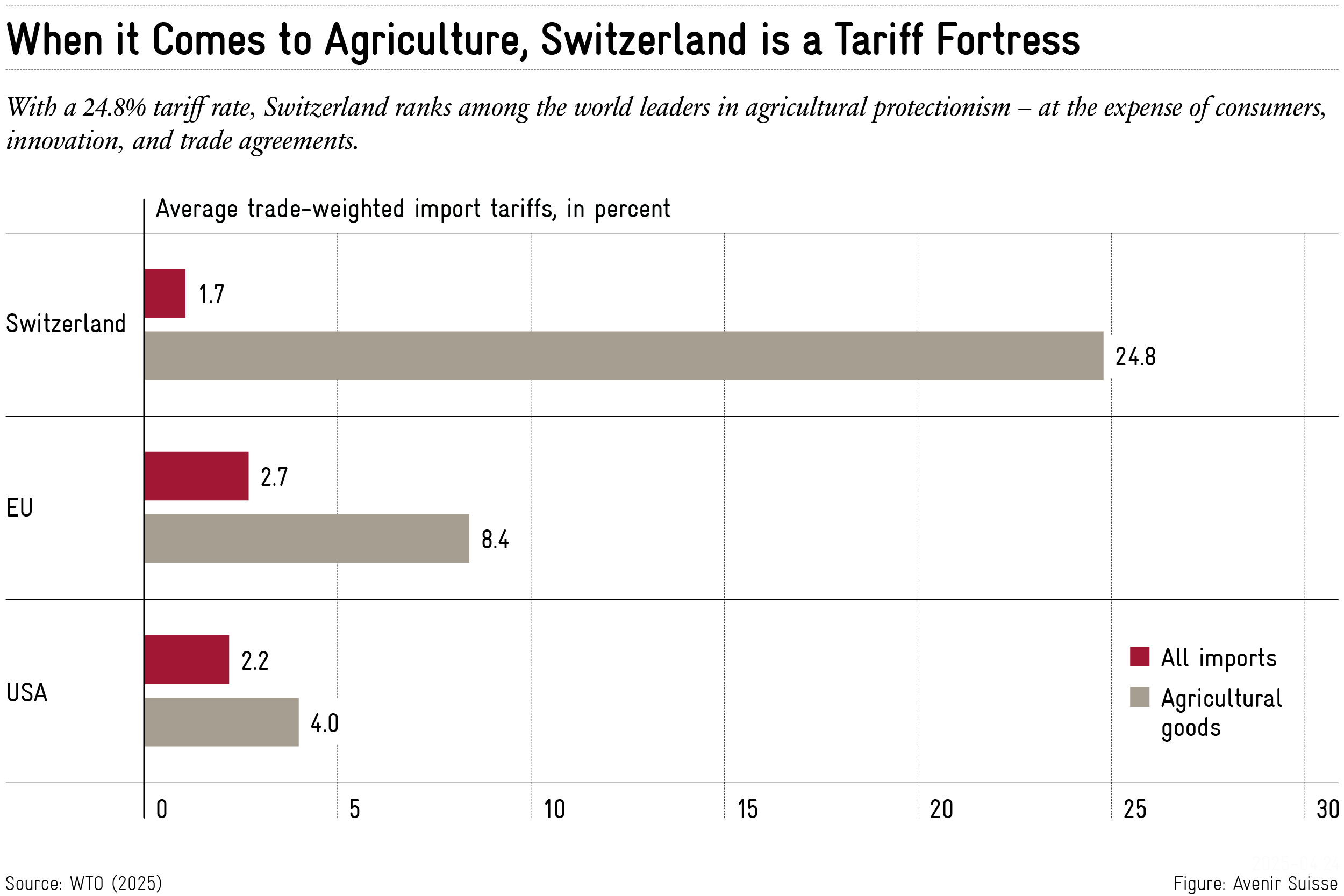
High agricultural tariffs increase food prices, burden low-income households in particular, and block new free trade agreements—not just with the U.S. At the same time, they contribute little to supply security and instead cement costly structures. A gradual, socially cushioned reduction would make economic sense and enhance credibility in foreign policy.
Three responses: tactical, strategic, sustainable
Whether the removal of agricultural tariffs would appease Trump is questionable. The bigger question, fundamentally, is: what to do when economic logic fails in trade policy? Neither yielding nor giving up is the answer—what is needed is sovereign action with a clear line.
Three things are needed:
- Smart, tactical diplomacy toward the U.S., consistently representing one’s own interests, selectively willing to compromise—without abandoning fundamental principles or undermining the trust of other trading partners.
- A strategically oriented foreign economic policy aimed at enabling new trade agreements, deepening existing partnerships, and reducing economic dependencies.
- Sustainable domestic reforms that strengthen the business location in the long term—through the reduction of excessive regulation, targeted incentives for innovation, and reliable conditions for investment.
Liberal tradition instead of hysteria
Whether, when, and how exactly the U.S. tariffs will take effect is currently uncertain. But the announcement alone shows that those who want to withstand the storm must strengthen their own foundation. This applies to foreign trade but even more so to Switzerland’s business location as a whole.
Switzerland would do well to draw on its liberal tradition, rather than calling reflexively for government intervention. For example, there is speculation about direct federal influence on the drug prices of exporting companies—a measure that would not only be economically risky but also clearly contradict the market-oriented principles of our country.
Trump will not change, but Switzerland can strengthen its position: with smart diplomacy toward the U.S., acting tactically; with broadly supported foreign economic policy in a strategically challenging world; and with consistent domestic reforms—for sustainable competitiveness.
You can find more numbers, facts, and ideas in our Essential on foreign economic policy, as well as in the following articles:


