Swiss migration policy distinguishes between two principal pathways:
- Labor migration: Access to the labor market depends on nationality as well as the purpose and duration of the intended activity.
- Refugee migration: Switzerland grants asylum to people who face persecution in their home country on the basis of race, religion, nationality, political opinion, or membership in a particular social group, or when they must fear for their liberty.
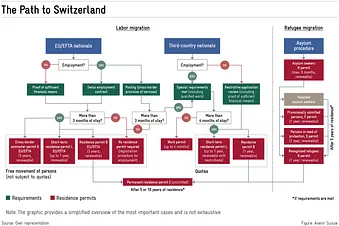
Both pathways are governed by different legal frameworks and follow their own principles. The diagram below illustrates the dual migration system and the main residence permit categories.
Pathway 1: Labor Migration
Access for EU/EFTA nationals
The Agreement on the Free Movement of Persons (FMP) between Switzerland and the EU grants EU/EFTA citizens the right to enter, reside, and work in Switzerland:
- Short-term employment (up to 3 months): Only an electronic notification is required.
- Longer-term employment: Requires a residence permit, typically issued and renewed with little difficulty when an employment contract is in place.
- Cross-border commuter permits are also possible, self-employment is permitted.
- Holders of (short) residence permits are entitled to family reunification.
Cross-border service provision is partially regulated by the FMP:
- Services up to 90 working days per year require notification but no permit.
- Services exceeding 90 days (unless covered by specific agreements) are subject to a labor market test and national quotas.
The FMP also grants residence rights to students and job seekers, provided they have sufficient financial means. Admission to educational institutions and access to scholarships, however, are not covered by the agreement.
Access for Third-Country Nationals
Nationals of non-EU/EFTA countries only have limited access to the Swiss labor market. Requirements include:
- specialized qualifications (e.g., executives and highly skilled professionals with university degrees)
- proof that no suitable candidate is available in Switzerland or the EU/EFTA area (the expanded Switzerland/EU/EFTA “priority for nationals”)
- an overall economic interest for Switzerland
Employers must document compliance with these criteria through an extensive procedure. The number of initial work permits is capped by annual quotas. For 2025, the quotas are:
- 4,000 short-term permits (up to 1 year, renewable to a maximum of 2)
- 4,500 residence permits (1 year, renewable)
Work assignments under four months and extensions of existing permits are not subject to quotas. Separate, temporary quotas apply to workers from the United Kingdom.
Cross-border service provision and self-employment from third countries are regulated as strictly as regular employment. Family reunification is possible but conditional. Students from third countries require an admission letter from a recognized institution and proof of sufficient financial resources.
After a given duration of lawful stay, individuals may apply for permanent residence (C permit) — the most secure migration status: unlimited and not subject to conditions. The waiting period is five years for nationals of several predominantly European countries with which Switzerland has agreements; for others, the standard requirement is ten years.
New Switzerland–EU Agreement: What Will Change
The new negotiation package between Switzerland and the European Union includes the partial adoption of the EU Citizenship Directive (UCRL). The directive governs the right of EU/EFTA citizens to enter, reside, and access social benefits.
Under this partial adoption, a permanent right of residence would be introduced for EU/EFTA nationals. It could be requested after five years of uninterrupted residence with employment in Switzerland. Registered Jobseekers are considered employed, and the receipt of social assistance for up to six months does not count as an interruption.
The permanent right of residence would be unlimited and no longer tied to continued employment. It would also apply to family members. The new status does not replace the current permanent residence permit (the C permit); it exists alongside it. Unlike the C permit, the permanent residence right does not require meeting integration criteria such as language proficiency. It can be revoked only in exceptional circumstances — but not for job loss or reliance on social assistance.
In many respects, this new right would go further than the C permit, with one important exception: it does not grant eligibility for Swiss citizenship. Naturalization would still require holding a C permit. Under the new agreement, a uniform five-year minimum stay would apply to all EU citizens before they may apply for a C permit. Today, the waiting period varies by country — either five or ten years.
The agreement would also expand family reunification and give additional groups access to social assistance benefits.
Pathway 2: Refugee Migration
Anyone seeking asylum in Switzerland is assigned to a federal asylum center. The State Secretariat for Migration (SEM) examines the application. If Switzerland is responsible for the procedure (and not another country under the Dublin Regulation), the SEM initiates the asylum process. Asylum seekers receive an N permit for the duration of the procedure.
Depending on the outcome, the applicant receives a different legal status, each associated with specific rights:
- Recognized Refugees (B permit; 1 year, renewable): If refugee status is granted, the individual receives asylum and may remain in Switzerland permanently. Rights: regular residence, access to the labor market, family reunification.
- Temporary Admission (F permit; maximum 1 year, renewable): Granted to individuals whose asylum application has been rejected but whose return is unreasonable, unlawful, or impossible. Rights: temporary residence (a B permit may be requested after five years), access to the labor market, conditional family reunification after a waiting period.
- Protection Status S (S permit; maximum 1 year, renewable): For people granted collective protection — for example, during wartime. Rights: temporary residence, access to the labor market, family reunification.
After ten years of residence (or five years for those with very strong integration), individuals may apply for a permanent C permit, provided they meet the integration requirements.
Migration Insights
Migration is shaping Switzerland—politically, economically, and socially. Hardly any other topic is debated as intensely and emotionally. With its blog series on migration, Avenir Suisse sheds light on the many facets of immigration to Switzerland. We provide data and facts to foster a better understanding of Switzerland as a country of immigration.