At the beginning of August, the U.S. government imposed a 39% tariff on a wide range of Swiss export goods. This is especially problematic for two reasons: First, the tariff is among the highest ever levied and far above the rate applied to the EU, eroding Switzerland’s relative competitiveness. Second, excluding gold, roughly 19% of all Swiss exports go to the U.S., meaning a substantial part of the economy is directly affected.
It’s clear for Avenir Suisse: doing nothing is not viable. While international negotiations remain crucial, their outcome is beyond Switzerland’s immediate control. Domestically, however, policymakers do have room to maneuver—by improving framework conditions for business.
Domestic Reforms for Quick Impact
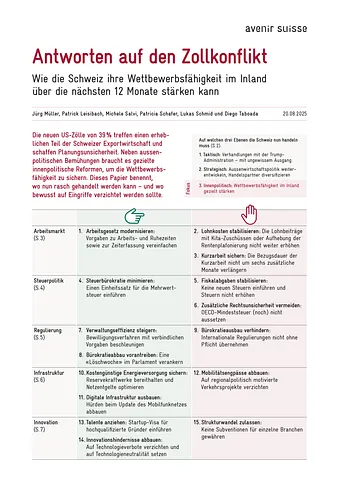
This analysis puts forward 15 measures in five key areas:
- Labor market: Modernize labor law, stabilize wage costs, prevent short-time work from becoming a permanent fixture.
- Taxation: Harmonize VAT rates, avoid raising the tax burden, refrain (for now) from suspending the OECD minimum tax.
- Regulation: Streamline approval processes, introduce a parliamentary “spring clean,” avoid adopting international rules without obligation.
- Infrastructure: Safeguard energy supply, accelerate the rollout of digital networks, drop transport projects driven mainly by regional politics.
- Innovation: Introduce startup visas, remove barriers to innovation, avoid sector-specific subsidies.
Avenir Suisse cautions against industrial policy quick fixes. Rather than propping up individual sectors with subsidies, Switzerland should focus on strengthening its overall resilience as a business location.
The recommendations call for evolution, not revolution: critically reassessing the status quo, making targeted improvements, and reinforcing the foundations of the Swiss economy. In an uncertain geopolitical environment, this would ensure that companies can at least count on a supportive domestic setting.