First, the good news: the Swiss Post is very efficient in its area of expertise. According to the Universal Postal Union, it often ranks first in terms of quality and reliability. However, this sector is in decline. Mail volumes are falling, and post offices are becoming less and less frequented. Unless action is taken, the Swiss Post faces the prospect of restructuring. In recent years, instead of tackling this challenge, politicians have been distracted.
The Federal Council has allowed expansion into areas of activity that have little to do with universal postal service. “[Swiss Post] helps meet the needs of the digital society and economy for safe and efficient communication,” according to Swiss Post’s strategic objectives. This had consequences. The Swiss Post has attempted to compensate for the decline in its core activity with a series of acquisitions in new areas, such as companies specializing in cybersecurity, enterprise software, and cloud services.
However, this path has led to a dead end. So far, the acquisitions have been loss-making and have led to increasing conflicts with private providers. Avenir Suisse therefore advocates a return to the Swiss Post’s core activity. Today, the Swiss Post is not only a logistics provider, but also a systemically important bank, a bus operator, and a digital service provider. Meanwhile, this vast conglomerate is wholly owned by the Swiss Confederation and is therefore highly politicized. This configuration is very problematic.
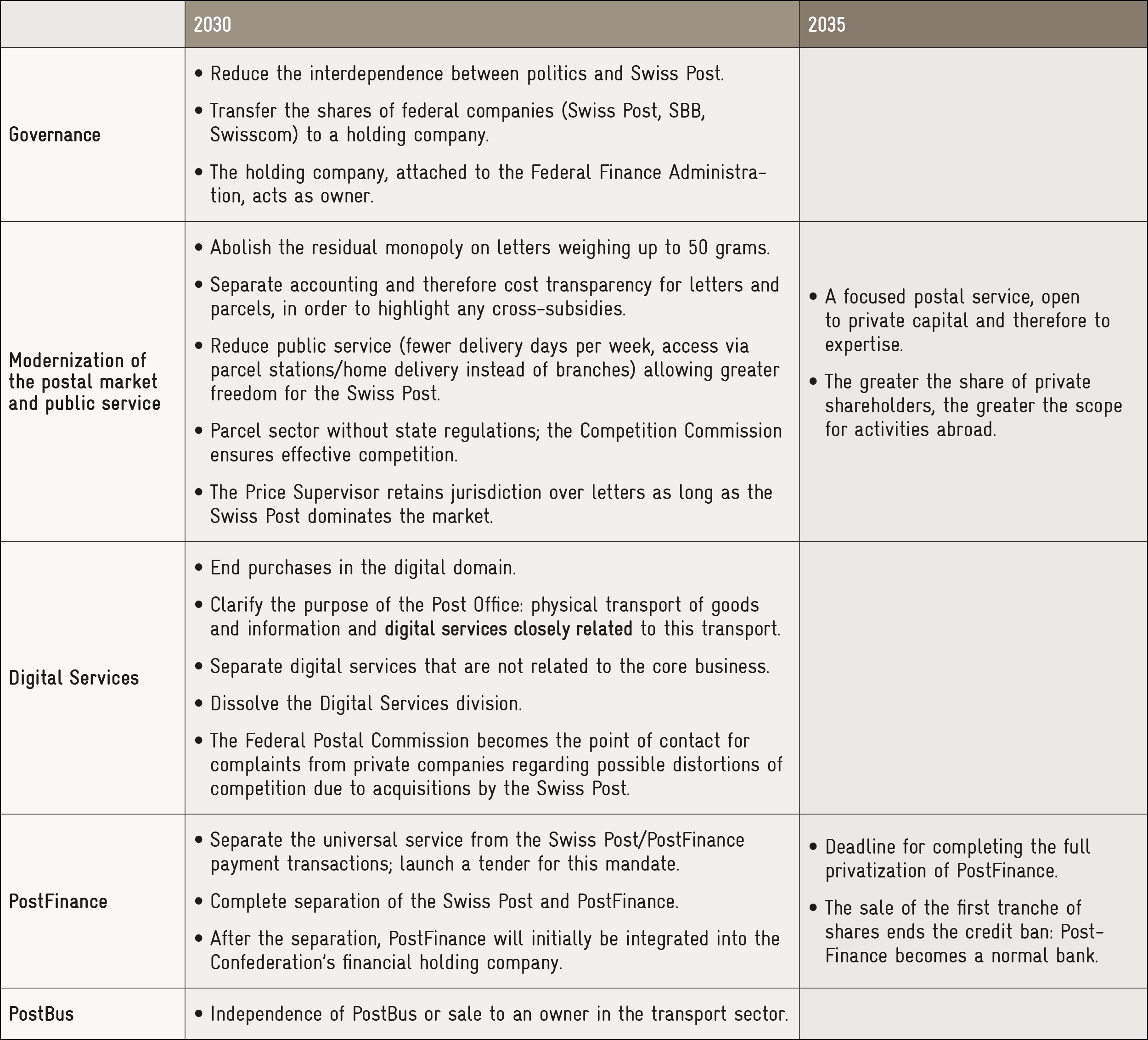
Avenir Suisse therefore outlines a five-point plan for policymakers to stabilize and refocus the group:
1. Distancing from politics: In the future, the Swiss Confederation will manage its stake in Swiss Post (as well as in other federal companies) through a holding company run by professionals and attached to the Federal finance Administration (FFA). This will allow operational management to refocus on the efficient and economical provision of postal and public services. The regulation of the postal market should be set by policymakers through ordinances and acts.
2. Modernizing the postal market: Competition is the best way to keep former monopolies in check. There is potential for competition in mass mailings, but this requires the removal of the residual monopoly on mail. The parcel market no longer needs state regulation. Therefore, the Competition Commission can ensure effective competition in this market.
3. Focusing on core business: The Swiss Post is a “champion” in the transport of letters and parcels throughout the country. This core activity needs to regain its place as a priority in the company’s mission and the Federal Council’s strategic agenda. Where demand is changing due to digitalization, the public service must adapt. If the Swiss Post opens up to private capital and expertise, this could give it additional momentum, as demonstrated by Deutsche Post and Austrian Post.
4. Limiting digital expansion: As long as the Swiss Post remains a public company, it should limit itself to digital services closely related to its core activity. The series of acquisitions launched a few years ago in areas where private companies already offer services is not compatible with a public postal service. The Digital Services division should therefore be dissolved and services related to the core activity integrated into Swiss Post.
5. Moving towards autonomy for PostBus and PostFinance: Since there are virtually no synergies with the Swiss Post’s core business, the PostBus division should be spun off. It could then be managed independently or sold to an existing transport company. The same logic would apply to PostFinance. It should be sold in its entirety or floated on the stock exchange independently. In return, the credit ban would be lifted and PostFinance would become a normal bank.
Today, politicians expect the Swiss Post to provide exemplary service, pay high dividends to the federal government, and guarantee competitive neutrality – a set of expectations that contains many conflicting objectives. Avenir Suisse’s five-point plan offers a way out of this trilemma. The key measures are clear: “The aim is to dismantle obsolete public service structures and shift the focus of the Swiss Post back to its traditional strengths,” explains Christoph Eisenring, author of the study.