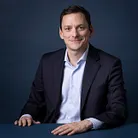
He is not the first journalist to lead the liberal think tank — nor the first with a past at “Neue Zürcher Zeitung.” Still, something felt almost revolutionary when Jürg Müller, an economist with a Ph.D., was appointed director of Avenir Suisse two and a half years ago.
This may be explained by the fact that he was 39 years old at the time, noticeably younger than his predecessors. Or that he never presents his views in a lecturing manner, but with curiosity. This becomes particularly evident in discussions where he repeatedly asks questions, sharing his knowledge with enthusiasm rather than condescension.
Republik asked Müller what he sets against today’s currents in global politics, and how well Switzerland’s political system is equipped to withstand them.
Republik: As someone who describes himself as liberal, how do you look at the United States today — and its president, the most powerful person in the free world?
Jürg Müller: With a knot in my stomach, of course. A liberal state depends on strong institutions such as a judiciary that is as impartial as possible, or an independent central bank. And state action should, as Max Weber would put it, follow rules and procedures. All of this is part of the much-invoked system of checks and balances. Power is divided and placed in a kind of organized competition, designed to keep authoritarian tendencies from gaining ground, ensuring that we can live freely. That is why I am deeply concerned when institutions are hollowed out and the separation of powers is weakened.
Would you say the Republican Party no longer has much to do with liberalism?
To label an entire party like that strikes me as difficult. What we are seeing in the U.S. is an example of polarization that exists in many countries. People’s thinking has narrowed — among Republicans and Democrats alike. The two-party system does not help. There is simply less diversity, and less political competition.
Consequently, does this mean democracy is less threatened in Switzerland than in the U.S.?
Thanks to its institutions, Switzerland is, to some extent, a showcase democracy in the liberal sense. Of course we have polarization here, too, a certain degree of political bloc thinking, a narrowing of perspectives. But we are much better positioned. Domestically, I am therefore less worried about Switzerland.
Or is the same development simply unfolding more slowly in Switzerland?
It is certainly slower, thanks to our institutions. Just think of direct democracy: initiatives and referendums function as early-warning indicators for public concern. These include worries about preserving nature or high levels of immigration. In Switzerland, these issues tend to be discussed broadly much earlier than elsewhere.
Additionally, the militia system and federalism contribute to a more grounded form of politics than what you often see abroad. On top of that, the country’s small size leads to shorter distances and makes interactions more frequent. All of this helps prevent polarization from becoming too extreme. Or how do you see it?
It seems to me we have lost the ability to listen to people with different political views — and to try to understand them.
Unfortunately, that tendency exists. This is even more pronounced among the highly politicized supporter base than among political decision-makers themselves. Many politicians in Switzerland still meet over a beer. Of course, there are extremists on both sides — I won’t mention names — but, in principle, there is still a willingness to meet each other halfway.
But not everywhere?
Overall, Switzerland is well positioned. But unfortunately, I do sense an increase in political bloc thinking, especially in circles that strongly identify with one political side. In these groups, people with opposing views are often spoken about in a contemptuous way. Over time, this becomes corrosive: instead of engaging with other perspectives, they deny the other side any legitimacy. It is no longer about stances on issues, but it becomes purely “us versus them.” It becomes identity-driven, which is dangerous.
Those highly politicized circles are also the ones most engaged. And they vote.
Yes, that is true. And it shapes the overall perception of politics — even though, behind the scenes, many politicians, regardless of their party, work hard on sound policies focused on concrete solutions.
Do you see other trends?
Political debate is increasingly shifting to the federal level, where media attention is focused, and where mobilization and polarization are easiest. Cantonal and municipal politics have lost significance. Yet specific issues are more often solved at these lower levels. The results of local politics are immediately visible and at the municipal level, a politician’s personality is often more relevant than their party affiliation.
Still, tackling challenges together locally no longer pays off in terms of political positioning. For media, parties, and voters, what is discussed at the federal level has become what really matters.
Are you personally close to a political party?
No.
Does that also mean that in elections you do not vote for parties, but for people?
Exactly. All over the map.
Which parties do most of the names you write down come from?
That is hard to say. Whether it is federal, cantonal, or municipal, I vote for those people who uphold liberal values.
A bit more specific, please.
I should say this first: I have never been in a political party, and I do not intend to be. I am politically interested and want to make a difference in this country. That fits Avenir Suisse perfectly. Of course, with some parties there is more or less overlap. The FDP has the word “liberal” in its name. But it also takes positions that drive me crazy.
Which ones?
Take tourism, for example — where it recently supported another extension of the reduced VAT rate. As a result, hoteliers continue to pay less taxes than, for example, a graphic designer or a carpenter. That has nothing to do with liberal economic policy.
Does that mean the FDP is not as liberal as you would like?
I do not think any party is one hundred percent liberal in the way I understand the term. Not even the Green Liberals, who also carry the word in their name. But parties are not think tanks. They serve a different function.
How do you define “liberal”?
In a way that many in Bern would probably view as detached from reality. For me, liberal above all means thinking from the bottom up. Apologies for the English expression — I used to get reprimanded for Anglicisms at the NZZ. By this, I mean a society and a state that are conceived from the bottom up. Tasks should be located where they can best be carried out. Ideally, waste disposal is organized and financed at the municipal level, regional public transport at the cantonal level, and the military at the federal level. This differs from liberalism in other countries, where the concept is sometimes reversed top down. This is a more elitist version of liberalism.
That sounds very abstract. Let me put it another way: what does liberalism aim for?
It is about trusting the individual to act responsibly. But that probably still sounds too abstract?
Yes, could you be a bit more concrete?
Ultimately, it is about seeing human beings as mature and responsible citizens. Our system expects people to take responsibility, vote, stay informed and act in this world with a degree of self-determination. This is the essence of liberalism: responsibility is not delegated. Institutions are designed so that each person carries a lot of responsibility but enjoys considerable freedom. I know it is not an easy message. In politics, it is much easier to make promises. And it is also much easier for people to rely on politics than to take responsibility for themselves and for others.
Is that why liberalism and political parties do not quite fit together?
They can fit together, but a party is a very practical entity. A society needs different actors. Parties channel interests and needs, which is why they are always seeking compromise. That is not a negative thing — quite the opposite. Consensus matters. People are different, our needs vary, and we must find common ground. Personally, I do not see myself in party politics. I prefer working in a think tank, thinking about institutions and trying to develop new ideas. I am not the one who represents interest and negotiates compromises in parliament— that is not my role.
Does it worry you that fewer and fewer young people vote?
Yes, definitely. Especially in Switzerland, with its system that requires a certain degree of engagement. I think the idea of a sense of the common good is underestimated across the political spectrum. It means taking responsibility for the larger whole out of inner conviction and starts with engaging honestly with other views during elections and votes. But it also means contributing to one’s own community through volunteering or participating in the militia system. A functioning society is not simply the sum of its individuals, as some libertarians suggest. Nor can a sense of the common good simply be outsourced to the state, as you sometimes hear from the left. Rather, it starts with the self-responsible individual — an inner spark that is ultimately essential for our liberal society to function.
And is this sense of common good under threat?
Yes, for many reasons. In my view, identity is one central question. It leads to difficult discussions because identity can be deeply constraining. In Switzerland, people used to identify strongly with their municipality and canton, but also with religious, linguistic- cultural identities that only partly overlapped with political entities. I always found that helpful. On the one hand, it ensured that people identified with the community where they lived and where politics took place. On the other hand, the layered nature of identity meant that people carried several loyalties at once. This naturally tempered each individual identity and encouraged consensus.
And that is no longer the case today?
Former religious and linguistic-cultural identities, especially among academics, have made room for new identities that are often shared across borders with like-minded peers. At the same time, identification with municipalities and cantons has declined. As I said, that means political positioning increasingly takes place at the federal or even global level. Similar developments can also be seen in other countries.
Can you give an example?
In the UK and the US, political scientists speak of “Anywheres” and “Somewheres” — and use that, among other things, to explain Brexit or the rise of Trump. The “Anywheres” are typically highly mobile academics, people who have studied or worked around the world — who are anywhere. Their identity no longer matches the institutions through which political decisions are made. They have become alienated from those structures. On the other side are the “Somewheres”: people who grew up in one place, work there, and identify with it. For example, someone who grew up in Pittsburgh, works in craftsmanship and goes to Steelers games. That divide fuels conflict.
What does that mean for Switzerland?
That divide is less pronounced, but we see the same trend. Political institutions and identities are drifting apart and migration reinforces this development. Many people engage where they feel a sense of identity. But when that no longer corresponds to arenas in which political decisions are made, local engagement declines — and with it the effectiveness of existing institutions.
If young people engage less politically because their lives are happening elsewhere, political engagement becomes the domain of older generations. Do you see that as a problem?
Demographics are a challenge on many levels. Especially in a direct democracy, they shift political weight. Reforms tend to become harder to achieve. There is also an economic dimension. Studies show that an increasingly older society becomes more risk-averse and innovation declines. Put simply, the share of the population that produces becomes smaller, while the share that does not produce becomes larger. That creates an imbalance we can address only if we discuss the retirement age. Our retirement age of 65 no longer fits our demographics. Some European countries have recognized this. Denmark, for example, which has linked its retirement age to life expectancy.
Does that mean we should do what Denmark did?
Yes, this is a matter of mathematics. We live longer, so we must work longer. When the old-age and survivors insurance (OASI) system was introduced in 1948, people who reached 65 lived, on average, another 13 years. Today it is 21. Therefore, it is obvious that we have to continue working for part of those additional years — especially since people are also healthier today. But I am aware that the political reality in Switzerland is different. Many European countries are already further along.
I perceive it as very mixed. In France, for instance, the retirement age is 63 …
Yes, France is the textbook example of how not to do it. Political reform deadlock, high debt, high spending on old-age insurance. In the long run, this model will not add up, because it costs an enormous amount of money. Incidentally, the retirement age is a powerful lever, since raising it means lower expenditures and higher revenues at the same time. That political parties have failed to find a compromise is fascinating.
“Antifragile Switzerland” is Avenir Suisse’s current book marking its 25th anniversary. In it you propose reforms. One proposal is to tie the number of signatures required for a popular vote to demographics, raising the threshold from 100,000 to 230,000. Honestly, I expected something more visionary from Avenir Suisse.
This proposal is linked to other ideas. For example, we also suggest introducing a legislative initiative at the federal level. Here the quorum would be set where it was when popular votes were introduced: namely, at 2 percent of eligible voters, which is slightly more than the 100,000 signatures required today. The idea is to further develop Switzerland’s popular rights. And believe me, even if you find this not very visionary, it meets strong resistance — much like raising the retirement age. The point is that much of the Swiss system does not need to be reinvented, but consciously refined, including with creative and new ideas. That is what we do in this book.
You praise federalism and how this small-scale structure creates proximity to citizens. That sounds to me like a contradiction with what Avenir Suisse demanded 20 years ago that Switzerland should be organized into six metropolitan regions rather than 26 cantons. Back then, federalism was said to hinder competition and create duplication. What happened?
We are enthusiastic about the principle of federalism, but we are very critical of how it has evolved, and address this openly. Especially when it comes to disentanglement, meaning the division of tasks between the federal government and the cantons. After the turn of the millennium, a lot moved in the right direction. Unfortunately, that momentum has weakened and we are now clearly heading in the wrong direction. We criticize what might be called “beggar federalism” — the practice of asking the federal government for money to finance cantonal responsibilities. This is not how federalism is meant to work.
Does that mean that the liberal think tank Avenir Suisse has moved away from grand, visionary ideas — and now wants to become more relevant again with more realistic proposals?
Yes, of course we want to be relevant. We have a vision of what Switzerland should look like. To make an impact, a think tank always needs both: visionary ideas for the future, and concrete reform proposals.
Is that not mainly a vision of Switzerland your donors want? After all, you are mainly supported by large, internationally active companies.
When Avenir Suisse was founded 25 years ago by a few large companies, there were no think tanks in Switzerland modeled on American examples. Since then, our base of supporters has steadily broadened. Today, we are funded by around 140 companies and private individuals, including many small and medium-sized businesses (SMEs). We want to broaden that base further. One of my goals is to have ambassadors from SMEs help spread our ideas and our message.
And what is that message?
That Switzerland is one of the most livable countries in the world. And that, here comes the uncomfortable part, this is not simply a given. If we want to continue living in a country that guarantees freedom, provides security and enables prosperity, we need to work constantly on our institutions. But that is only one part of the message. Just as important is the individual dimension. The success of our liberal society depends on people engaging and taking responsibility. And in the end, that also requires working on ourselves. Because assuming responsibility is a lifelong task, not a given.
This interview was conducted by Philipp Albrecht and published in the online magazine “Republik” on January 5, 2026.